A few years ago, Ashley said one true sentence to a friend about her family. It wasn’t cruel. It wasn’t exaggerated. It was just true.
And for days afterward, she was consumed with guilt. I’m prideful. I shouldn’t have said that. Who am I to talk about my family that way? She later told me that the guilt she felt for speaking about her experiences caused her almost as much pain as the experiences themselves.
If you grew up in a family where naming a problem was treated as worse than the problem itself, you probably know that feeling. And you’ve probably heard the phrase that’s supposed to end the conversation: You’re just playing the victim.
So is telling your story the same as playing the victim? No. But there is a real difference between speaking honestly about what happened and letting what happened become your whole identity. This is about learning to tell the two apart, and not letting anyone use one to silence the other.
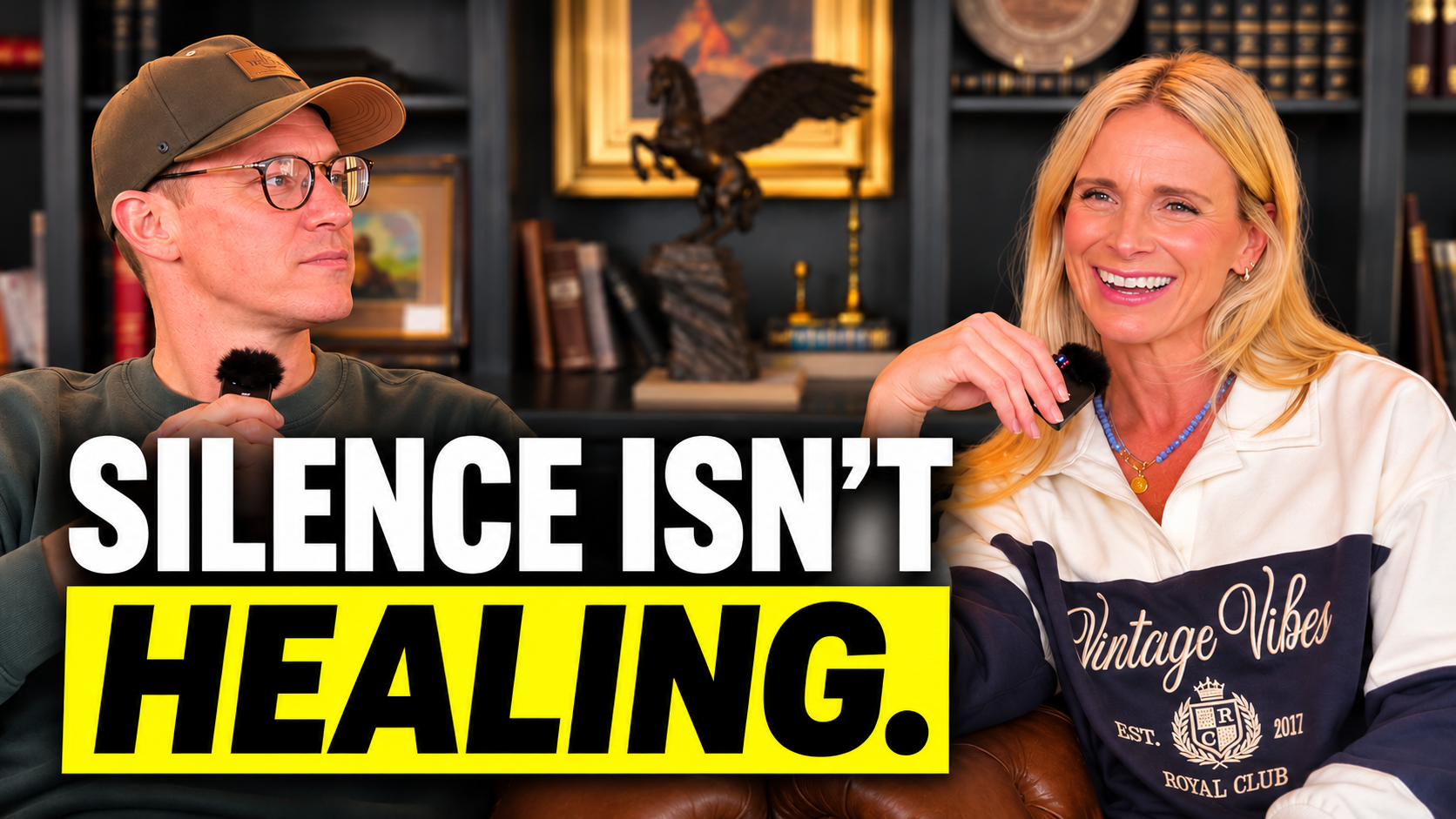
Watch the full episode of Cleave: The Podcast below.
Why Dysfunctional Families Discourage Truth-Telling
Many people who find our work have spent years as the quiet one. The people-pleaser. The person who carries the family’s unspoken burdens so nobody else has to look at them. You learn to suffer silently, and you often don’t realize how much you’re carrying until it builds up.
You may have even been taught to deny your real feelings to yourself. So when you finally start to speak, it feels terrifying. Not just because the subject is painful, but because of how the people you love react.
That reaction is often surprising. The people who benefited most from your silence are frequently the same people who helped create an environment where you weren’t allowed to speak. When you start naming what happened, you may hear:
“You’re holding a grudge.”
“You can’t forgive.”
“That’s in the past.”
“That’s not yours to judge.”
“You’re just gossiping.”
“You’re such a victim.”
These phrases work because you’ve heard them your whole life, usually about other people who stepped out of line. They taught you what happens to people who talk. So when they’re turned on you, it’s easy to believe them.
How “Playing the Victim” Gets Used to Silence You
Psychologists have a name for one of the most common patterns here: DARVO. It stands for Deny, Attack, and Reverse Victim and Offender.
It looks like this. You bring something into the light: a harmful pattern, a hurtful event, a concern about your children. Instead of engaging with it, the family denies it happened, attacks you for raising it, and then recasts themselves as the injured party. Suddenly you are the offender, and they are the victims of your accusation.
“Playing the victim” is often the centerpiece of that reversal. It takes the attention off what happened and puts it on the supposed character flaw of the person who spoke.
In our own family, this showed up as a simple message: You’re not perfect, so stop talking. We weren’t raising concerns because we thought we were perfect. We were raising them because something was harmful, and it was affecting our children. But the conversation shifted away from the behavior and onto us.
That pattern is so common that it shows up in what we call the five unwritten rules of dysfunctional families:
Harmful behavior must be minimized, justified, or ignored.
People are expected to protect the family’s image.
Naming a problem becomes more offensive than the original behavior.
The person who speaks is accused of being bitter, divisive, unforgiving, or attention-seeking.
The conversation shifts away from what happened and toward the supposed character flaws of the person who spoke.
If you recognize your family in that list, the accusation of “playing the victim” may say more about the system than it does about you.
Victimization, Validation, and Victim Identity
Part of the confusion is that three different things get lumped together. It helps to separate them.
Victimization is when something harmful or unjust happened to you. Acknowledging it is simply a recognition of reality.
Validation is recognizing that your experience and its impact are real and worthy of attention.
Victim identity is when the harm becomes so central to your understanding of yourself that you struggle to see your capacity for choice, growth, or a future beyond it.
Saying “this happened to me, and it hurt” is not victim identity. It’s honesty. Victim identity is something different: when the injury becomes the lens through which every relationship, every decision, and every future possibility has to be viewed.
One person who comes to mind is Elizabeth Smart. What she endured is almost impossible to read about. And yet she has spoken her truth, all of it, for years, without letting it define her. She has used her experience to advocate for others, to help change laws, and to give survivors hope that healing is possible. Nobody listens to her and thinks, “When is she going to move on?” Her story is part of her life. It isn’t the whole of it.
Why Speaking Your Truth Matters
When you start to speak about what happened, something shifts. Before you say the words, there’s confusion. You might think it, but saying it out loud makes it real in a way that’s much harder to deny.
That’s exactly what happened for Ashley. That one sentence, and the guilt that followed, eventually became the turning point. Speaking it out loud moved her from “this is happening” to “what do I want to do about it in my life?” She realized there were patterns in her family that had affected her more than she knew, and she didn’t want to hand those patterns to our children without realizing it.
Scripture has a lot to say about this.
Genesis 1:3. God creates through speech: “Let there be light: and there was light.” Words are powerful. They can create good, and they can create harm.
John 8:32. “And ye shall know the truth, and the truth shall make you free.”
Ephesians 5:11–13. Paul teaches followers of Christ not to participate in works of darkness, but to expose them. That challenges the assumption that Christian unity always requires silence.
Luke 8:17. Christ teaches that hidden things will be revealed.
For years, Ashley read that last verse and thought, Christ will reveal it, in His time and His way. That was much more comfortable, because it meant she didn’t have to speak. Eventually she came to see it differently: often Christ calls on us to be co-creators and participants in His work, including the work of bringing hidden things into the light.
It can feel easier to stay silent. In many ways, it is easier, at least in the short term. Speaking the truth always costs something. But silence costs something too. What it ends up costing you is your very soul. You shrink and shrivel as a person. You give up far more than you realize, thinking you’re doing something noble, when in reality you may be causing harm, even to yourself.
Silence isn’t healing.
Intent Matters: Telling Your Story vs. Retaliating
Does that mean you need to shout every detail from the rooftops? No. Some things can and should stay private, and the Spirit will guide you on what that looks like.
What it really comes down to is intent. Ask yourself why you’re speaking:
Am I trying to verbally process and make sense of what happened?
Am I trying to educate, or help someone else in a similar situation?
Am I trying to protect my children or my marriage?
Or am I trying to slander someone’s name, retaliate, or harm them?
Am I trying to stay in the injury because it has become comfortable?
The first set of motives is healthy. The second set needs to be kept in check. That’s where the internal work comes in, and it’s what separates telling your story from using it as a weapon.
Processing vs. Rumination
There’s another honest question worth asking: am I processing, or am I ruminating?
Processing helps you make sense of what happened, recognize its impact, and gradually integrate it into a larger understanding of your life. You gain wisdom, and you keep going. The experience doesn’t disappear, but it becomes part of who you are rather than all of who you are.
Rumination can feel like processing, because you’re still talking about it. But rumination is repeatedly revisiting painful questions without gaining meaningful clarity or finding a constructive way forward.
Ashley and I have been stuck in rumination at times. We’ve both had nights where one of us said, “I need a break from this conversation.” Healing isn’t a straight line, and we haven’t done it perfectly.
Ashley also had a friend who listened to her talk through the same things, again and again, for hours. Looking back, she isn’t sure how much of that was rumination and how much was simply what it took to process forty years of experiences, both her own and those she witnessed in others. Probably both. If you have someone like that, be grateful. If you don’t, look for one. There won’t be many people with the capacity to carry that with you, and that’s okay.
Letting Go of the Need for Accountability
One of the biggest things that keeps people stuck in rumination is the desire for accountability and justice. That desire makes sense. Of course you want the people who hurt you to acknowledge it.
But eventually many people come to a point where they realize: I can’t make them take accountability. I can’t make them change. I can’t make them grow.
And then a harder realization follows: I don’t need that in order to heal and move on.
Would accountability be wonderful? Absolutely. Should you still want justice? It’s human to want it. But justice ultimately belongs to Christ. And if you stay in the place of waiting for accountability that may never come, you’re still letting those people have power over you.
5 Movements to Reclaim Your Story
Here’s a framework we use. Think of these as movements rather than steps. They aren’t linear, and you don’t have to go in order.
Name what happened. Stop minimizing or rewriting your experiences just to make them more comfortable for others. Distinguish what you know, what you felt, and what you may still be uncertain about.
Acknowledge its impact. Give yourself permission to recognize how it affected your trust, relationships, self-worth, and sense of safety. You don’t have to minimize pain to demonstrate strength.
Grieve what was lost. Sometimes the deepest loss isn’t the relationship as it existed. It’s the relationship you hoped you could have. Grieve the family, the apology, or the repair that may never come.
Reclaim your agency. Recognize the difference between what you couldn’t control then and what you can choose now. Boundaries, safe relationships, support, and new patterns are all part of reclaiming your freedom.
Build a life bigger than the injury. Let your story become one part of your life, rather than the lens through which every future relationship and experience must be interpreted.
Make It a Jesus Story
Years ago I heard a simple idea that has stuck with me: every story in our lives should be a Jesus story. If you’re the focus of your story, it may be worth looking at again.
When we’re in victim mentality, we’re the subject of the story. The question becomes: How do I make this a Jesus story?
For Ashley, the answer has been finding out who she is through Christ, and the strength and sense of self He brings. Three years ago, she would have told you her heart would break over this forever. Today, what happened is still true, and she will never say it didn’t happen. But it’s no longer the most interesting thing about her life. Compared to who she knows she is, and the hope and possibilities ahead, it has become small.
When I served my mission in Japan, I learned about kintsugi, the art of repairing broken pottery by binding the pieces together with gold. The breaks don’t disappear. They become part of something more beautiful than it was before.
That’s what the Savior does. Yes, there are things that broke you. Let yourself be rebuilt. See yourself through the lens of the Savior, not the lens of the people who hurt you. “I can do all things through Christ which strengtheneth me” (Philippians 4:13).
The Big Idea: Honest, Not Defined
Telling your story isn’t playing the victim. Dysfunctional families often use that accusation to protect the image and keep the truth quiet. But speaking honestly is only the beginning. The goal isn’t to live inside the injury. It’s to name it, grieve it, learn from it, and build a life bigger than it.
You can acknowledge what happened without letting it decide who you are.
Keep Reading
Why Dysfunctional Families Turn Against the Person Who Tells the Truth
Why Dysfunctional Families Demand Forgiveness Without Accountability
A Resource for People Walking Through This
If you’ve been told you’re “playing the victim” for speaking about your family, Ashley and I wrote Christlike Boundaries for you. It’s about recognizing unhealthy patterns, telling the truth without losing your faith, and setting boundaries that protect your peace.
You can read the first chapter free here:
Get the free chapter of Christlike Boundaries
And if you want support from people who understand, the Cleave Community includes weekly live Q&A with Ashley and me, small faith-centered support groups, and the full Christlike Boundaries course. You can try it free for 14 days.
Frequently Asked Questions
Is telling your story the same as playing the victim?
No. Acknowledging that something harmful happened to you is a recognition of reality. Victim identity is different: it’s when the harm becomes so central to how you see yourself that you struggle to see your capacity for choice, growth, or a future beyond it.
Why do families accuse you of playing the victim?
Often because naming a problem threatens the family’s image. In dysfunctional systems, the conversation shifts from what happened to the supposed character flaws of the person who spoke. This is a common part of DARVO: Deny, Attack, and Reverse Victim and Offender.
What is the difference between processing and rumination?
Processing helps you make sense of what happened and integrate it into a larger understanding of your life. Rumination repeatedly revisits painful questions without gaining clarity or finding a way forward. Both can feel like talking about it, but only one moves you forward.
Is it biblical to speak about family pain?
Scripture repeatedly values truth and light. John 8:32 says the truth shall make you free, Ephesians 5:11–13 calls believers to expose works of darkness, and Luke 8:17 teaches that hidden things will be revealed. Intent still matters: speaking to process, protect, or help others is different from speaking to retaliate.
How do I stop letting what happened define me?
Name what happened, acknowledge its impact, grieve what was lost, reclaim your agency, and build a life bigger than the injury. For many people of faith, that means finding their identity in Christ rather than in what someone else did to them.
