What Are Toxic Family Dynamics? 7 Signs and How They Affect You as an Adult
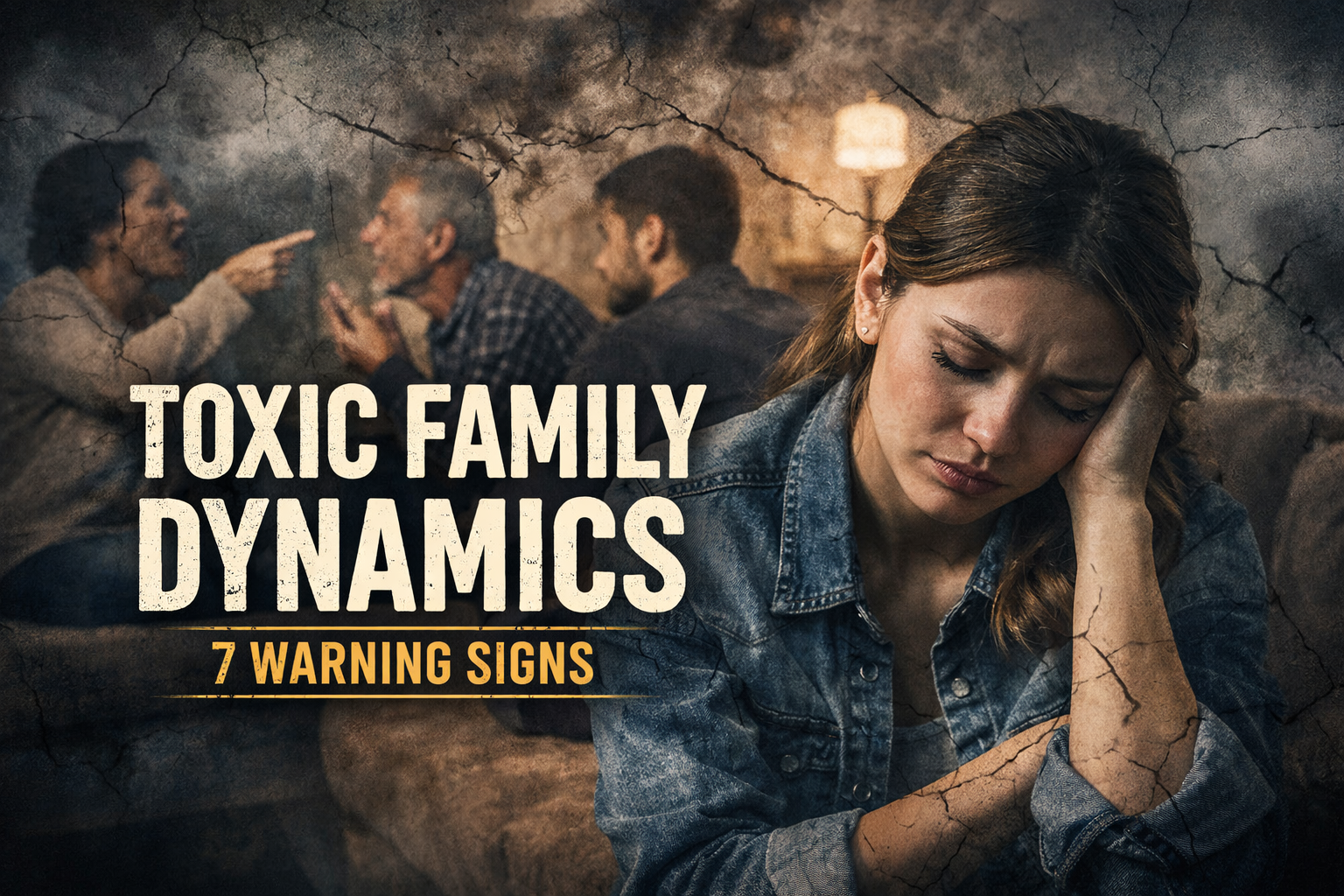
A moody, emotionally charged image showing a young woman sitting in the foreground with her head resting in her hand while blurred family conflict unfolds behind her. The dark tones, cracked texture, and distressed atmosphere visually represent the confusion, pressure, and emotional pain often present in toxic family dynamics.
Family is supposed to be a place of safety, belonging, and support. But for many people, family does not feel safe at all.
Instead, it feels confusing. Heavy. Draining. You may leave conversations second-guessing yourself. You may feel guilty for having needs. You may find yourself constantly trying to keep the peace, explain yourself, or manage other people’s emotions. And even if you cannot fully explain what is wrong, you know something has felt off for a long time.
This is often what toxic family dynamics feel like.
Toxic family dynamics are not just about conflict. Every family has conflict. The deeper issue is the pattern underneath the conflict. It is the unspoken system that keeps certain people in control, certain people quiet, and certain people carrying burdens they were never meant to carry.
If you grew up in a family like this, the effects often do not end in childhood. They follow you into adulthood, into your marriage, your parenting, your faith, your nervous system, and your sense of identity.
In this article, we will look at what toxic family dynamics are, seven common signs of them, and what healing can begin to look like.
What are toxic family dynamics?
Toxic family dynamics are unhealthy relational patterns that repeatedly cause harm, confusion, instability, fear, shame, or emotional exhaustion within a family system.
This does not mean your family is imperfect. Every family is imperfect. A toxic dynamic is something deeper and more chronic. It is when harmful patterns become normal. It is when truth is avoided, accountability is resisted, and certain roles or behaviors are reinforced in order to keep the system intact.
In toxic families, peace is often valued more than honesty. Image is often valued more than health. Loyalty is often demanded, but safety is not always provided.
These patterns can show up in subtle ways or extreme ones. Sometimes the dysfunction is obvious. Other times it is hidden beneath religion, family closeness, generosity, success, or tradition. From the outside, the family may look admirable. From the inside, it may feel suffocating.
7 signs of toxic family dynamics
1. You are expected to keep the peace at any cost
In many toxic family systems, harmony is prized above truth.
That means family members are discouraged from bringing up hard things. If someone lies, manipulates, explodes, gossips, or mistreats others, the pressure often falls on everyone else to move on, stay quiet, or avoid “rocking the boat.”
You may have learned that speaking honestly makes you the problem. You may have been told you are too sensitive, too dramatic, too unforgiving, or too difficult simply because you named what was happening.
Healthy families value repair. Toxic families often value silence.
2. Boundaries are treated like betrayal
One of the clearest signs of a toxic family dynamic is that healthy boundaries are interpreted as cruelty, rebellion, or disrespect.
Maybe you tried to say no. Maybe you asked for space. Maybe you stopped participating in gossip or refused to be the family messenger. Instead of your boundary being respected, you were punished for it emotionally.
This might look like guilt trips, coldness, spiritual shame, silent treatment, triangulation, or a smear campaign meant to make you question yourself.
In healthy families, boundaries help relationships function. In toxic families, boundaries threaten the system because they interrupt patterns that benefit other people.
If this is something you have wrestled with, you may also want to read [Why Do I Feel Guilty Setting Boundaries With My Parents?] and [How Do I Know If I Should Go No Contact With My Family?]
3. Roles are rigid and unhealthy
Toxic families often assign unspoken roles to different people.
One person becomes the peacemaker. Another becomes the scapegoat. Another becomes the golden child. Another becomes the fixer, caretaker, or emotional support person for everyone else. These roles may shift over time, but the system often depends on them.
The problem is that these roles do not allow people to be whole. They flatten people into functions.
Instead of being allowed to mature into their own identity, family members are often rewarded for staying in their assigned lane. The strong one stays strong. The compliant one stays compliant. The truth-teller gets punished. The needy one keeps the attention on themselves. The parentified child keeps carrying what the adults should have handled.
Over time, you may not even know who you are apart from the role you played.
4. Direct communication is missing
In toxic family systems, people often do not speak honestly and directly to each other. Instead, communication gets rerouted through other people.
This is where patterns like triangulation often show up.
A mother talks to a daughter about the father instead of speaking to him directly. A sibling pulls another sibling into a conflict to gain support. An in-law uses one family member to pass along pressure, guilt, or criticism rather than having an adult conversation.
This creates confusion, divided loyalties, and chronic emotional tension.
If that word resonates with you, it may be worth writing a full article next on triangulation because many people live inside this pattern without having language for it. For now, it is enough to say this: healthy families deal with conflict directly and respectfully. Toxic systems recruit third parties and spread the emotional burden around.
5. Image matters more than reality
Some families care deeply about how they appear to others, but very little about what family members are actually experiencing.
This can be especially disorienting in families that appear religious, generous, successful, tightly connected, or highly respected in the community. The outside presentation may be polished, while the inside reality is full of fear, denial, favoritism, gossip, volatility, or emotional neglect.
When image matters more than reality, family members often learn to perform instead of tell the truth. They may smile in public and suffer in private. They may defend the family name while quietly carrying grief, confusion, or trauma.
This can make healing harder, because it becomes difficult even to admit that something unhealthy is happening.
6. You feel responsible for other people’s emotions
If you grew up in a toxic family system, you may have learned early that it was your job to manage other people’s moods.
You may have tried to keep a parent calm, comfort a parent who leaned on you too much, protect siblings, anticipate conflict, or smooth things over before things escalated. You may still feel deeply responsible for keeping everyone okay.
This often follows people into adulthood. You may overexplain, overfunction, over-apologize, or feel immediate guilt when someone is disappointed with you.
But being emotionally aware is not the same as being emotionally responsible for everyone.
This is one reason toxic family systems are so exhausting. They train people to carry emotional loads that were never theirs to begin with.
7. Telling the truth leads to backlash
In healthy families, truth can be painful, but it makes repair possible.
In toxic families, truth often gets punished.
The person who finally names the dysfunction may be labeled divisive, unstable, bitter, disrespectful, selfish, or ungrateful. Instead of the harmful pattern being addressed, the focus shifts to the person who exposed it.
This is often the beginning of scapegoating.
When a family system depends on denial, the truth-teller becomes dangerous because they threaten the illusion. And when image, loyalty, and control matter more than honesty, the system will often move to protect itself rather than confront what is broken.
Common toxic family patterns
There are several patterns that commonly show up in toxic family systems. These are worth learning because they help people move from vague confusion to clearer understanding.
Triangulation
This happens when conflict is routed through a third person rather than handled directly. It creates loyalty binds, confusion, and emotional pressure.
Enmeshment
This happens when family members are overly involved in each other’s lives, feelings, decisions, or identities in a way that erodes healthy individuality.
You can read more about that in [What Is Enmeshment in Families and How Do I Break Free?]
Parentification
This happens when a child takes on emotional or practical responsibilities that belong to the adults. They may become the caretaker, counselor, mediator, or stabilizer in the family.
Scapegoating
This happens when one family member becomes the one blamed for the tension, dysfunction, or emotional discomfort of the group. Often, it is the person who begins telling the truth or resisting unhealthy roles.
Each of these patterns deserves its own article, but together they form a helpful framework for understanding what many people mean when they talk about toxic family dynamics.
How toxic family dynamics affect you as an adult
Many adults minimize the impact of the family they came from. They tell themselves it was not that bad. They compare their story to more extreme ones. They assume that because no one hit them, they should be fine.
But toxic family dynamics can shape adult life in deep and lasting ways.
You may struggle with:
chronic guilt
anxiety before or after family interactions
difficulty trusting your own judgment
people-pleasing
fear of conflict
confusion about boundaries
attraction to unhealthy relationships
overexplaining yourself
emotional exhaustion
shame when you disappoint others
a fractured sense of identity
tension in your marriage because extended family still has too much influence
You may also feel grief. Not just grief over what happened, but grief over what never was. The safety you needed. The support you wanted. The honesty you hoped for. The family closeness that looked real from the outside but never felt secure on the inside.
That grief is real.
Can toxic family dynamics change?
Sometimes they can. But only when there is genuine humility, honesty, and willingness to take responsibility.
Not every family system changes just because one person sees the pattern clearly. In fact, sometimes the more clearly you see it, the more resistance you face.
That can be heartbreaking, especially for people of faith or people who deeply love their family. It is painful to accept that love does not always lead to mutual health. It is painful to realize that closeness without safety is not true intimacy.
Still, healing is possible, even if the whole family never changes.
What healing can look like
Healing does not always begin with a dramatic confrontation. Sometimes it begins with language. With finally naming what has felt confusing for years.
From there, healing may include:
learning to trust your own perception
stepping out of unhealthy roles
setting boundaries without overexplaining
grieving what you did not receive
protecting your marriage and children from repeating the pattern
finding safe people who value truth and accountability
getting support through counseling, coaching, faith, or wise community
accepting that peace and pretending are not the same thing
Healing may also mean choosing distance for a season. In some situations, it may even mean no contact. That decision is deeply personal and often painful, but for some people it becomes necessary.
If you are wrestling with that question, you may want to read [How Do I Know If I Should Go No Contact With My Family?]
You are not crazy for feeling the weight of this
One of the most painful parts of toxic family dynamics is how hard they are to explain.
From the outside, people may say, “But they are your family.” They may not understand why a phone call leaves you shaken, why a holiday feels loaded, or why a simple boundary creates major fallout.
But recurring confusion, fear, guilt, emotional pressure, and truth-punishing patterns are not small things. They affect the soul. They affect the body. They affect the way you move through relationships.
If you have felt trapped between loyalty and truth, love and wisdom, grief and clarity, you are not alone.
And you are not crazy for wanting health.
Final thoughts
Toxic family dynamics are not always loud. Sometimes they are quiet, polished, spiritualized, or hidden beneath the language of love and closeness. But if the system repeatedly demands your silence, punishes your honesty, blurs your boundaries, or makes you responsible for everyone else’s emotions, something deeper is wrong.
The good news is that naming the pattern is often the beginning of freedom.
You do not have to keep carrying what was never yours.
You do not have to keep calling dysfunction normal.
And you do not have to betray your own soul in order to stay connected.
If this article resonated with you, you may also find these helpful:
If you want deeper support, you can also:
Book a Clarity Conversation
Or join us for our next event or Live Workshop!
