How to Protect Your Marriage From Toxic In-Laws
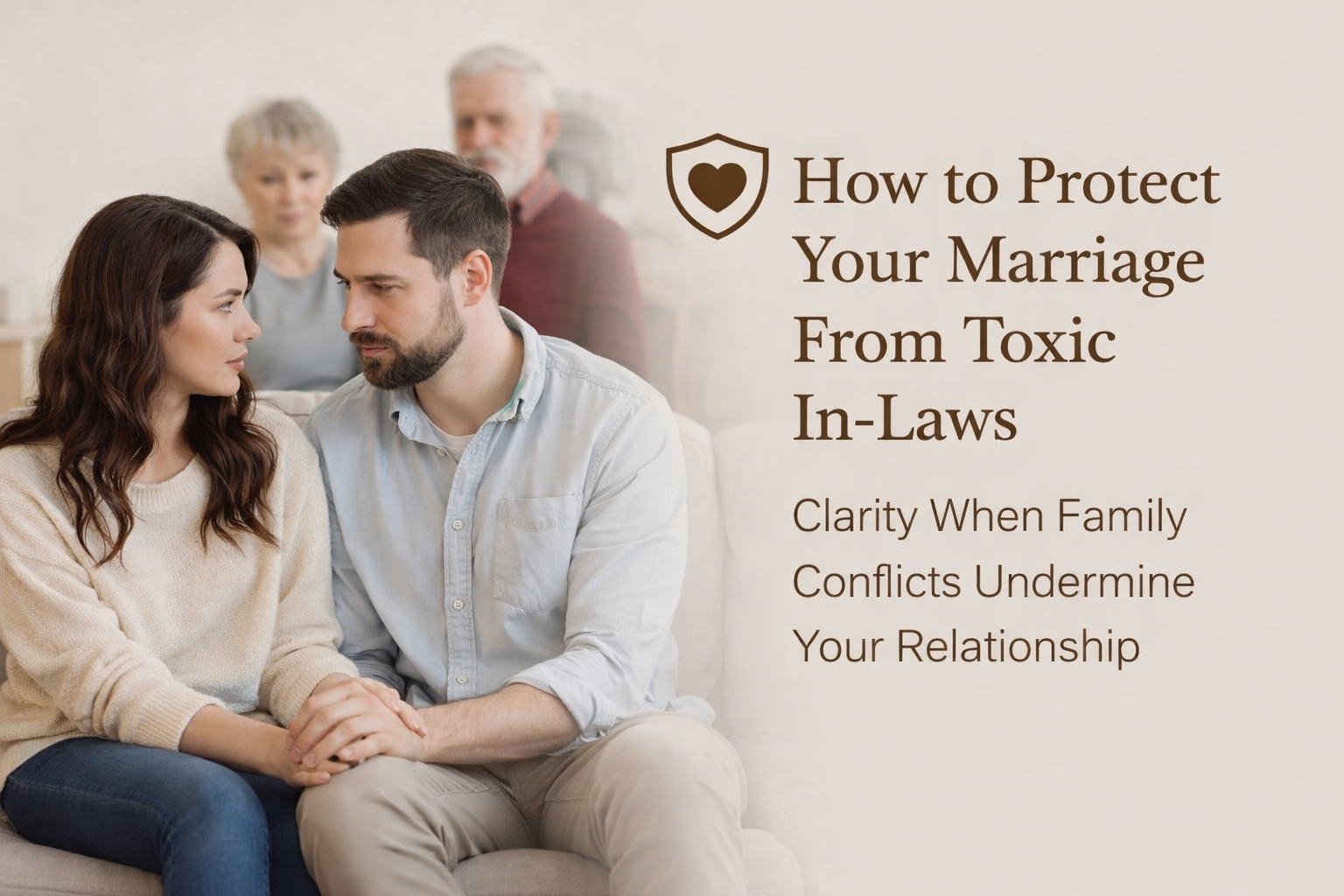
If your in-laws are constantly creating tension in your marriage, you are not overreacting.
A lot of couples minimize this for far too long because they want to be respectful, keep the peace, or avoid looking dramatic. But when outside family members keep intruding, manipulating, criticizing, dividing, or undermining the marriage, the damage is real.
Protecting your marriage from toxic in-laws is not about being cruel, reactive, or childish. It is about honoring the covenant and clarity of your marriage. A healthy marriage cannot thrive when extended family is allowed to dominate it.
If you have been asking yourself whether things are “bad enough” to address, this article is for you.
What do toxic in-laws actually look like?
Toxic in-laws are not just in-laws who are annoying, opinionated, or occasionally difficult.
The bigger issue is usually a pattern.
That pattern might look like:
constant criticism of your spouse
guilt-tripping around holidays, time, or attention
inserting themselves into private marital decisions
creating loyalty binds between a spouse and their family of origin
using money, access, religion, or family expectations to control behavior
playing the victim whenever boundaries are set
triangulating by texting one spouse separately or turning siblings and relatives against the couple
disrespecting parenting decisions, household rules, or emotional limits
acting entitled to access, influence, or information that does not belong to them
Not every difficult family dynamic is abuse. But many marriages stay stuck because they keep treating a destructive pattern like it is just a personality quirk.
Why toxic in-laws affect marriage so deeply
In-law conflict is rarely just about the in-laws.
It often exposes something deeper:
unresolved enmeshment
old survival roles from childhood
confusion about biblical or spiritual ideas like honor, forgiveness, or family loyalty
a spouse who has never learned that marriage requires a new primary allegiance
This is why the issue can feel so loaded. You are not just dealing with rude comments or difficult visits. You are often dealing with a whole family system.
And family systems do not give up power easily.
The biggest mistake couples make
The biggest mistake is treating this like a small communication problem when it is actually a boundary problem.
Many couples keep trying to “explain better,” “wait for a better time,” or “avoid upsetting people.” But if the pattern is chronic, more explaining usually does not solve it.
Why?
Because unhealthy people do not usually resist boundaries because they are confused. They resist boundaries because the boundary changes what they have access to.
That is why you can say something calmly, kindly, prayerfully, and respectfully—and still get backlash.
Backlash does not always mean the boundary was wrong. Sometimes it means the boundary was necessary.
How to protect your marriage from toxic in-laws
1. Get clear that your marriage is the primary relationship
This is the foundation.
If either spouse still acts like their parents’ feelings outrank their spouse’s safety, peace, or trust, the marriage will keep getting injured.
Marriage requires a shift. Your spouse is no longer competing with your family of origin. Your spouse is your family.
That does not mean parents no longer matter. It means they no longer occupy the central place of influence.
If that shift has not happened emotionally, boundaries will always feel optional.
2. Stop arguing about whether the in-laws “meant it”
Intent matters less than impact.
One of the easiest ways couples stay stuck is by debating the heart, motives, or hidden intentions of the family member causing harm.
You may never fully know their motives.
But you can know this:
If the behavior repeatedly creates fear, confusion, division, guilt, pressure, or disrespect in your marriage, then it needs to be addressed.
You do not have to prove malicious intent before you protect your peace.
3. Decide together what is no longer acceptable
Get specific.
Vague frustration does not help couples act with unity. Clear agreements do.
Ask:
What behaviors are harming our marriage?
What access has been too open?
What topics are no longer up for group debate?
What happens when someone disrespects one of us?
What information about our marriage, finances, parenting, or decisions needs to stay private?
You are not just identifying what hurts. You are defining what changes now.
4. Let the spouse whose family it is take the lead
This matters more than many couples realize.
When one spouse is constantly forced to defend themselves against the other spouse’s family, resentment builds fast. The marriage starts to feel unprotected.
As a general rule, each spouse should take primary responsibility for addressing their own family of origin.
That does not mean the other spouse has no voice. It means the message lands differently when it comes from the son or daughter whose family is crossing the line.
It communicates maturity, separation, and unity.
It says: “We are aligned. You do not get to come between us.”
5. Use simple boundaries, not long emotional speeches
When people are scared of conflict, they often overexplain.
But long explanations usually invite argument.
Try something more direct:
“That does not work for us.”
“We are making this decision together.”
“We are not discussing our marriage with extended family.”
“If that continues, we will need to end the visit.”
“We are not available for that.”
“We will let you know what we decide.”
Boundaries are not about convincing. They are about clarifying.
6. Expect guilt, pushback, or escalation
This is where many couples panic.
They finally set a boundary, and the in-laws respond with outrage, tears, blame, scripture-twisting, smear campaigns, silent treatment, or family pressure. Then the couple assumes they made the wrong move.
Not necessarily.
When toxic patterns are interrupted, the system often protests.
That does not mean you are being unloving. It often means the old pattern is no longer working.
You do not measure the health of a boundary by how pleased unhealthy people are with it.
7. Protect private spaces in your marriage
Some marriages are being slowly weakened because there is no protected boundary around the couple’s inner life.
Your marriage needs private space.
That includes:
private decision-making
private conflict repair
private conversations
private parenting choices
private spiritual discernment
private financial decisions
Once extended family feels entitled to weigh in on everything, the couple bond weakens.
Not every opinion deserves access.
8. Watch for triangulation
Triangulation is when tension between two people gets rerouted through a third person.
Examples:
a parent texting one spouse about the other
siblings getting pulled into private marriage conflict
relatives pressuring one spouse to “be more understanding”
a parent complaining to the grandchildren
one spouse venting to family instead of dealing directly with the marriage
Triangulation keeps confusion alive.
Healthy marriages reduce triangles and strengthen direct communication.
9. Do not confuse honoring parents with obeying them forever
A lot of adults feel trapped here.
They were raised to believe that honoring parents means endless access, endless agreement, or endless tolerance. But honoring someone does not mean permitting harm.
You can be respectful without surrendering your discernment.
You can be kind without being controlled.
You can honor parents without allowing them to interfere with your marriage.
Sometimes the most mature form of honor is telling the truth clearly and refusing to participate in unhealthy patterns.
10. Get help if your spouse cannot separate
Sometimes the real issue is not the in-laws. It is that your spouse is still emotionally fused with them.
If your spouse cannot say no, constantly minimizes the problem, turns on you to keep their family comfortable, or expects you to endure chronic mistreatment for the sake of “family,” then deeper work is needed.
That does not automatically mean your marriage is doomed.
But it does mean this issue will not be fixed by one hard conversation at Thanksgiving.
It may require counseling, coaching, deeper family systems work, and honest reckoning with how loyalty, fear, and identity were shaped long before the marriage began.
Signs your marriage needs stronger boundaries with in-laws
You may need stronger boundaries if:
one spouse feels emotionally abandoned during family conflict
your decisions constantly get revisited because of family pressure
visits leave one or both of you dysregulated for days
parents expect access that feels intrusive or entitled
one spouse is afraid of their family’s reaction to basic adult choices
guilt drives most of your decisions
your marriage feels less peaceful after every interaction with extended family
one spouse feels like the outsider in their own home or relationship
If those patterns are present, this is not something to keep brushing off. In this article we discuss “how you know if you should go no contact with your family”.
What protecting your marriage does not mean
Protecting your marriage does not mean:
being rude
cutting people off impulsively
retaliating
humiliating family members
refusing all repair forever
making your spouse choose between love and cruelty
It means building a marriage where clarity is stronger than control.
Sometimes that looks like firmer communication. Sometimes it means distance. Sometimes it means very limited contact. In more severe cases, it may even mean no contact for a season.
But the goal is not punishment.
The goal is peace, truth, and protection.
Final thoughts
If toxic in-laws are harming your marriage, the answer is not endless accommodation.
The answer is clarity.
A healthy marriage needs loyalty, privacy, courage, and boundaries. And if those boundaries upset people who benefited from overreach, that does not mean you are doing something wrong.
It may mean you are finally doing something necessary.
If you and your spouse are in the middle of this right now, you are not weak for struggling. Family pressure can be powerful. Loyalty binds can run deep. But your marriage deserves room to breathe.
And sometimes protecting it begins with one honest sentence:
This is not working, and it cannot keep going like this.
If this resonates, take your next step toward clarity. You can book a clarity conversation, download the free chapter of Leave Then Cleave, or listen to the podcast.
Frequently Asked Questions:
This is not working, and it cannot keep going like this.
Can toxic in-laws ruin a marriage?
Yes, especially when there are weak boundaries, divided loyalty, triangulation, or chronic interference that goes unaddressed.
Should my spouse confront their own parents?
Usually, yes. In most cases it is healthier for each spouse to address issues with their own family of origin.
Is it wrong to limit contact with in-laws?
No. Limiting contact can be a healthy response when repeated behavior is harmful and boundaries are not being respected.
What if my spouse always takes their parents’ side?
That usually points to a deeper issue with enmeshment, fear, or unresolved family loyalty. It often requires more than one conversation to change.
